


Photo Alchemy
 Photo AlchemyThe workbench
 Collage and montageCut and rebuilt
 African Art FusionWith Simon Shone


 Majestic Panoramas
More collections


Twenty eight collections, and more being added
Photo AlchemyThe workbenchCollage and montageCut and rebuiltAfrican Art FusionWith Simon Shone
Photographs made in pieces and rebuilt into a picture that was never there. Three series of montage by Martin Osner, and one of collage.
The two words get used as though they mean the same thing. In Martin's studio they do not.
Montage is one subject. It is either repeated, or broken into segments and reassembled, so the picture is made from a single thing seen many times. Analogous Anthology, Mirror Island and Earth Wind and Fire are montages.
Collage is looser. Different elements from different places are brought together into one presentation, so the picture is made from many things seen once. Kings & Queens are collages.
"What I love about this type of work is that it is so experimental. When you sit back and look at it, it seems so simple. When you are making it, you soon realise there is nothing simple about it, because it brings rhythm and pattern together at the same time, and then all of that has to be coordinated within one colour palette."
Prints are sold through Osner Gallery, shipped worldwide.
See Analogous Anthology No.1Analogous Anthology, Mirror Island and Earth Wind and Fire. Tap any picture to see it larger. The collages are further down the page.
 Analogous Anthology No.1
 Analogous Anthology No.2
 Analogous Anthology No.3
 Analogous Anthology No.4
 Analogous Anthology No.5
 Analogous Anthology No.6
 Analogous Anthology No.7
 Analogous Anthology No.8
 Analogous Anthology No.10
 Mirror Island No.2
 Mirror Island No.1
 Mirror Island No.4
 Mirror Island No.7
 Earth Wind and Fire No.1
 Earth Wind and Fire No.2
 Earth Wind and Fire No.3
Analogous Anthology No.1 began on the underside of an old fishing boat. The weathered paint and the worn gunwale were photographed in segments and reassembled, and out of them came a Dutch harbour, inlets and distant cranes under a winter sky, that was never there.
In 2013, while Martin was running his first fine art photography gallery and still working on it, his wife came in to look. She does not naturally gravitate towards abstract work, so he has learnt to pay attention when something stops her. She looked at it for a moment and said: "That's going to be a winner."
It became one of the three best selling works in the gallery's history, and only a few prints of the edition of fifteen remain.


 No.2, No.4, No.6, No.7, No.8 and No.10, with No.3 and No.5 below
Weathered, peeling paint on the corrugated iron of fishermen's huts along the sea, photographed with side light so the ridges carry the rhythm. The second in the series, and the plainest proof of how far one ordinary surface can go.

Stone walls and weathered signage at a client's property on the coast, with a rusted house number as the one hard note among the stone. Photographed in soft, overcast light.

Textures made by stamping paint onto different surfaces, each with its own colour and grain. Nothing was forced to match, and the variation is what holds it together.

Spare sheets of paper that took the excess paint from a roller while Martin was working on a commission. The colour was left as bold as it came off the roller.

An early morning seascape at a fishing harbour that did not work in the overcast light. On the way out, the painted markings underfoot made an X, and that became the picture. The one monochrome piece in the series.

Nine quiet variations of tone and texture, each panel holding its own atmosphere. The one piece in the series that is painted rather than photographed, in paint and ink on metal, 75 x 75 cm.
"These pieces, and especially the anthologies, can start from anywhere. But generally it is recognising a texture and a pattern in your subject, and recognising it is the single most challenging part."
"I think we live life with blinkers on, and we do that just to cope with life, so we are normally not on the lookout for a possible subject."
"What I like about the anthologies is that I stumbled across them along the way. It might be in the studio with a painting, something goes all wrong, you look down and say, OK, if we break this into segments we have an anthology."
"It is the ability to push yourself to be aware of what is around you."

"You are having a meal outside at a street café, and across from you there is a wall that is breaking up and needs serious repair. Some people will see the repair, but the artist in me sees the art."
Photographed in segments, the scratched orange and grey surface was reassembled into the suggestion of a dancing figure.

"No.5 was an error. I was transferring from one medium to another in the studio, used too much transfer medium, and the ink started running."
"After it dried I realised it could easily be, and would be, put into a very attractive anthology." Turquoise running into neutral beige and a trace of reddish brown.
 No.1, the sky over Hout Bay
 No.2, a winter afternoon over the Atlantic
 No.3, Table Mountain made from rock
Earth Wind and Fire is a direct influence from David Hockney, and from his joiners in particular. Each scene is photographed section by section, then loosely montaged back together, so the edges never quite meet and the picture keeps moving.
Martin was introduced to Hockney's work by one of his own students, Sandy Mclea, who is now one of the artists shown at Osner Gallery.
"I have always loved the contact sheet look you get from classic darkroom printing, and I think this is a natural progression from it."
No.1 is the sky from the studio above Hout Bay, horizon to horizon, reassembled so the scene reads as an impression of itself rather than a record.
No.2 was photographed over the Atlantic on a winter afternoon, strong wind and heavy cloud moving across the whole sky.
No.3 is not a sky at all. Twenty five photographs of rock beside a pool near a waterfall on Table Mountain, rebuilt into the shape of Table Mountain itself, with Devil's Peak on the left and Lion's Head on the right.
Signed limited editions of fifteen, 80 x 80 cm and 110 x 110 cm.

Trees photographed once, then mirrored both ways, so a horizon appears in the middle of the picture and the trees become an island floating in its own reflection. Nothing in the scene was ever water.
No.2 is the most popular in the series: autumn leaves turning orange against a cool blue ground, lit from behind so the light comes through the branches.
Once the series was made, Martin put the method into his teaching. Mirror montage is one of the lessons in Going Further in Art Photography.
Signed limited editions of fifty, 80 x 80 cm and 110 x 110 cm.


 Mirror Island No.1, No.4 and No.7
Photographed during a drought in the Western Cape, when the dry trees looked stark and fragile. The beige of the branches sits against the cool blue of a mountain in shadow.

Autumn trees on an island that does not exist, the warmest of the four.

The outer trees frame the picture and draw the eye round in a slow circle, which makes it the one piece in the series that moves inward rather than across. Warm ochre against cooler blue.
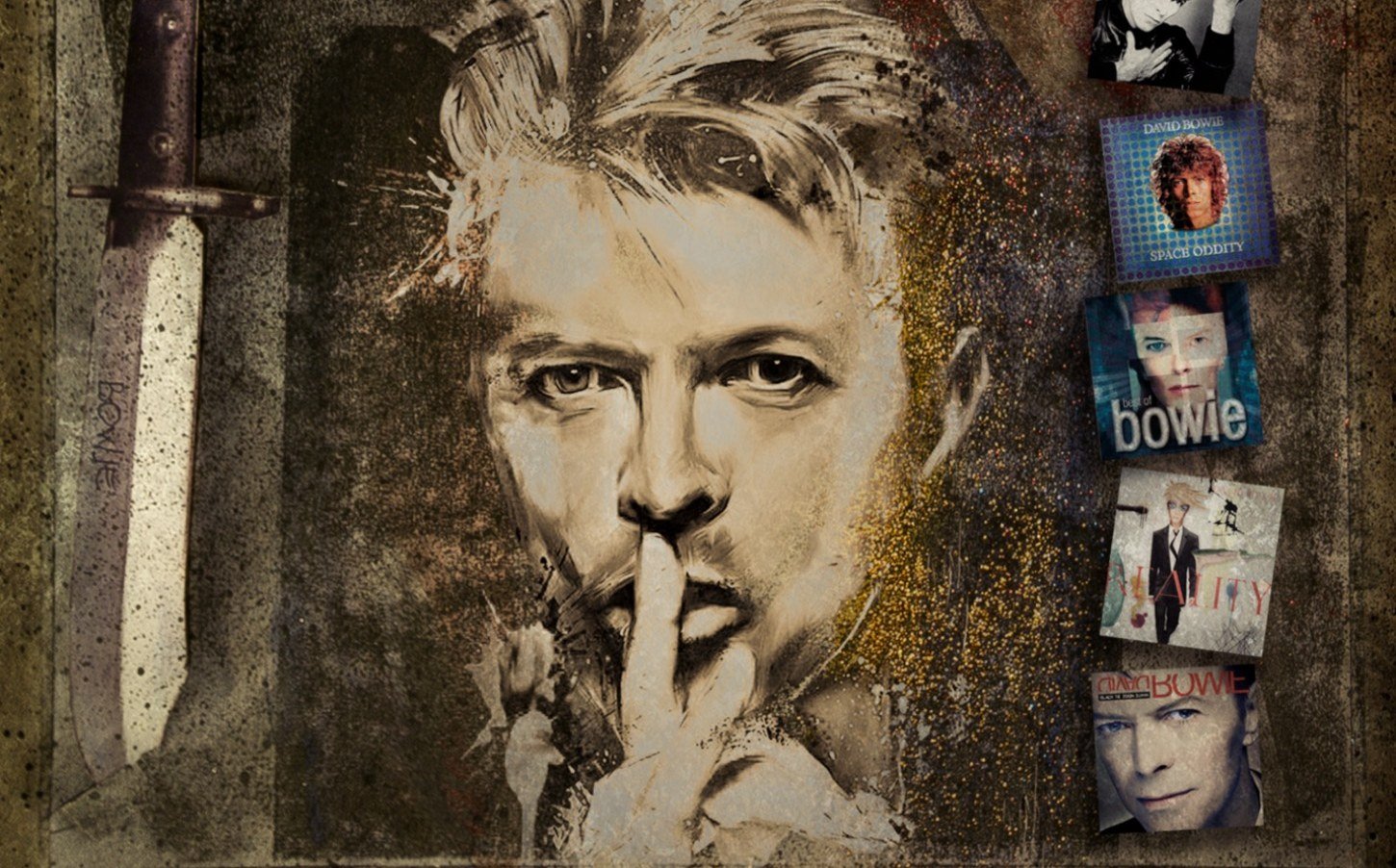
This is the collage side of the page. Each piece is built by hand in three dimensions from vintage posters, newspaper headlines, album covers, candid pictures and symbolic textures, all gathered from different places, and the finished construction is then photographed under studio light so it keeps its real depth and shadow.
They are made to look like cinema posters, and they hang best where people talk: a music room, a restaurant, a bar.
Hard to Handle is Marilyn Monroe, and the gap between the public icon and Norma Jean, the private person underneath.
Let's Dance is David Bowie, from Space Oddity to Blackstar, and the man who kept reinventing himself. It is also the picture at the top of this page.
MJ is Michael Jackson, headlines, film strip and all.
Signed open editions, archival prints on fine art paper.

Sold through Osner Art Gallery online, shipped worldwide, and shown in person at Osner Gallery in Hout Bay.
Go to the gallery
Online courses at the Art Photography Academy, live fine art classes on Zoom, and workshops on location.
See the courses


